
On completing big life goals

This wasn’t something I ever planned to do, at least not at first.
As a senior in high school, I very actively avoided chemistry and physics. I was going to be an artist, that much I was sure of. But when it came time to apply to college and choose a major, I found myself checking the box for Environmental Science. I didn’t really know what that meant. I just knew that I liked science, and I loved the environment. It felt like a reasonable combination, even if I didn’t yet understand where it could lead.
Westminster College turned out to be exactly what I needed. It was small, quiet, and grounded; a liberal arts college nestled in the heart of Amish country. I was surrounded by students and faculty who genuinely cared about the Earth and who believed in the Scientific Method, and their passion was contagious. Realizing I needed to catch up in chemistry and physics, I dove in headfirst. Despite being very intimidated and relying heavily on tutors, I found myself absorbing the earth sciences like a sponge, eager to understand and protect the systems shaping the world around me.
More than any class, though, my time at the field station shaped who I became. My boss, Dr. Clarence Harms, was nearly 60 years my senior, but he taught me lessons that had little to do with data sheets or protocols. He taught me how to care: about people, about the planet, and about taking the time to listen. Visitors came through often, former students from prior decades, neighbors, curious passersby. No matter how much work we had to do, Clarence always made space for conversation, connection, and kindness. He invited me to do the same.
Everything we did at the Westminster Field Station was in service of the environment. We recorded weather and solar data, maintained community gardens and public trails, planted native trees, and taught students how to identify macroinvertebrates in the streams. And through it all, we talked about life, about the Earth, about what it means to be a good steward of something larger than yourself.
Despite the gap between us (a teenage girl and a man with decades of lived wisdom), Clarence always cared about my thoughts and opinions. He treated them as valuable, worth hearing. "Erin, what do you think about _____________", I would hear out of the blue on the regular.

And hearing about his lifetime dedication to the Earth was transformative. I wanted to live that way too.
That desire carried me across the country to Clinton, MO to research fish, to Nashville, TN to study mosquitoes, to Ithaca, NY and Delaware to work with ticks, and eventually to SUNY ESF in Syracuse where I studied wetlands and greenhouse gases. Each place taught me something new, not just about ecosystems, but about responsibility, curiosity, and care.
SUNY ESF was exactly the place for me. With “Environmental Science” being in the school’s name, everyone there cared about the planet in many different ways. From sustainable architecture, environmental justice, environmental engineering, conservation, and forestry. Our biggest campus celebration was Earth Day, which we celebrated for a full week, ending in a music festival. I finally found my people here, and my desire to have a career in this field was solidified.
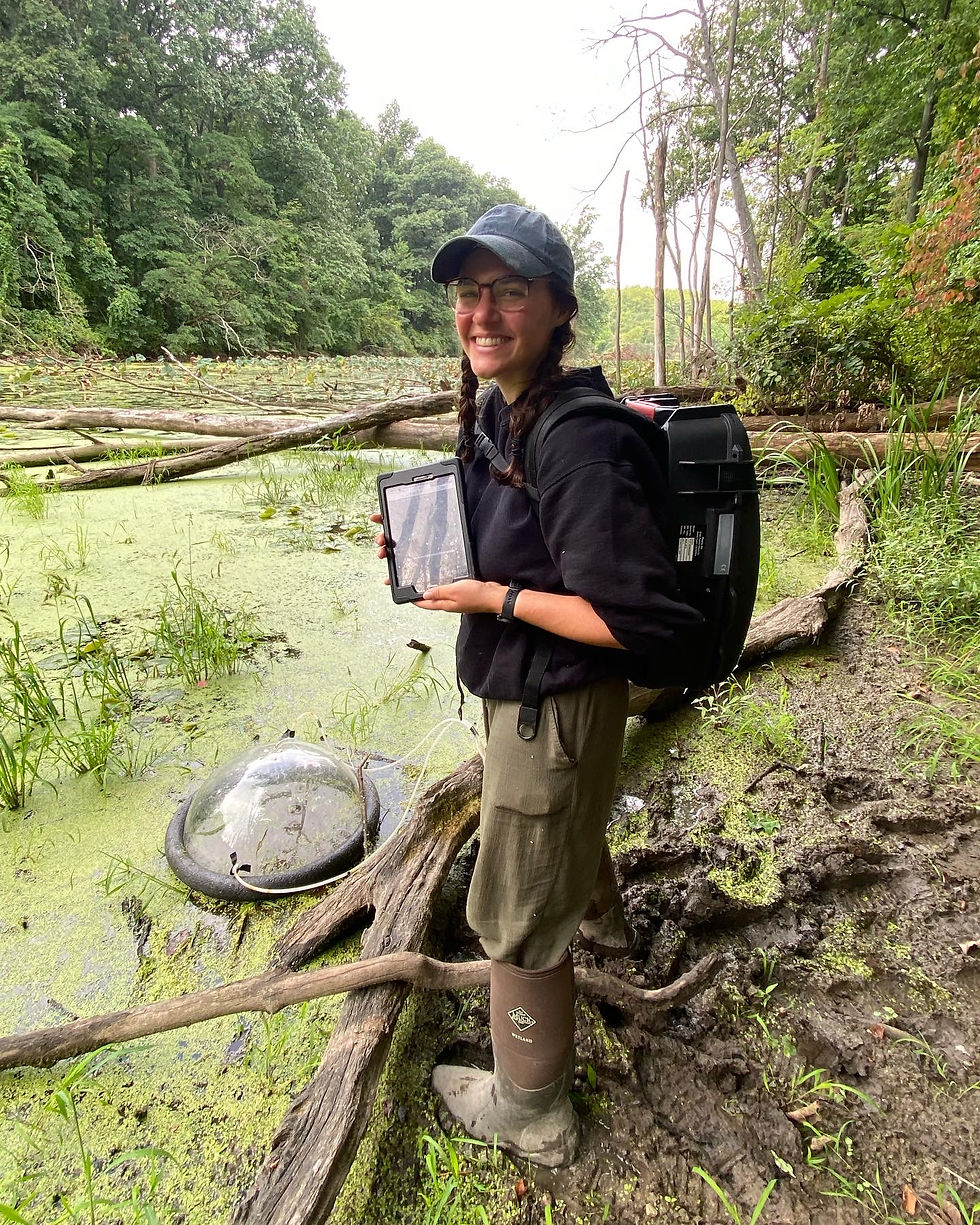
I don’t know exactly what the future holds. But I do know this: I want to treat the Earth tenderly. I want to care for its inhabitants, human and nonhuman alike. I want to work toward a cleaner, more just future, and to support science and legislation that protect the fragile systems that sustain us. If nothing else, I hope to move through the world with the same quiet dedication Clarence showed me: paying attention, listening closely, and choosing, over and over again, to care.
I also know, without question, that I could never have done any of this alone. Every step forward has been made possible by the patience and belief of so many people who carried me when I doubted myself.
My parents and brothers gave me endless support, even when my path didn’t make sense on paper. The friends I’ve met along the way, across states, disciplines, and phases of life, have enriched me more deeply than I ever knew was possible. They reminded me to laugh, to rest, and to stay human in spaces that can so easily make you forget yourself. Importantly, they taught me to live more slowly and consciously.
I am profoundly grateful to the mentors who saw something in me before I fully saw it myself. Dr. Diana Ortiz encouraged me to apply to Cornell and helped me secure the internship in Nashville that kept me on an academic path when I might have drifted away from it. Dr. Helen Boylan instilled in me a deeper love for environmental science, teaching me the fundamentals while also showing me how knowledge can be lived, through projects like the Tiny House build where I learned how we can reduce our carbon footprint at home, not just in theory but in practice. Dr. Abelardo Moncayo inspired me to keep going toward a PhD; I admired his work at the Tennessee Department of Health and the way he bridged science, policy, and care for communities.
And throughout the uncertainty and the exhaustion, the four states, two degrees, and one pandemic, my boyfriend (and now husband) stood beside me through it all. His love, patience, and belief in me made the hard days survivable and the good days even brighter. All of it was better with Uri by my side.
I thank everyone who was with me through this, in any capacity, and I look forward to using my New Important Piece of Paper (!) to help make the world a better place.


Comments